
Decay is a range, not a yes or no. Early mineral loss can sometimes be stopped. Here is how the decision is made and what to ask.
Share:
Summary:
The short answer, before anything else
Tooth decay is a range rather than a yes or no.
NIDCR describes it this way: acid from bacteria attacks the enamel and causes it to lose minerals. At that early stage, often visible as a white spot and usually without symptoms, NIDCR says tooth decay can be stopped or reversed. Enamel can rebuild using minerals from saliva and fluoride, from toothpaste or applied by a dentist or hygienist. NIDCR adds that if decay has not yet formed a hole, a dentist can apply fluoride to reverse it.
If the enamel keeps losing minerals faster than it recovers, it breaks down and a cavity forms. At that point NIDCR says dentists commonly treat cavities by filling them.
So the useful question is not a single yes or no. It is where on that range is this tooth, and what are the options at that point. Ask to see the finding on the x-ray or photograph, and ask what the plan is if you wait.
Nothing hurts. You have no symptoms. Someone looks in your mouth and tells you a tooth needs filling. Wanting that explained is reasonable, and a good practice will welcome the question.
Use these anywhere. A practice that answers them clearly is one you can work with.
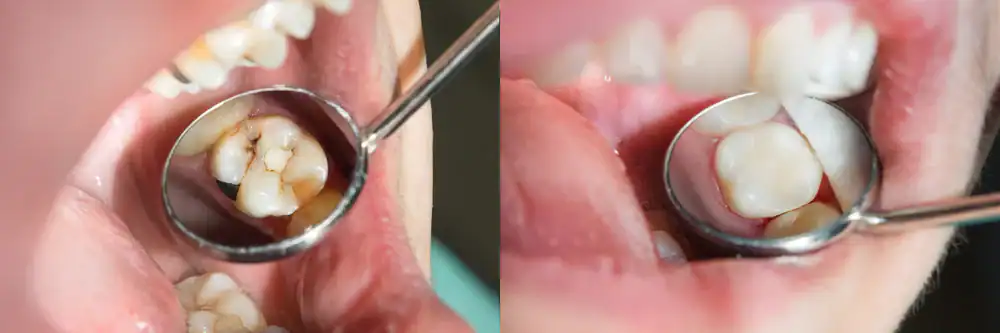
NIDCR says tooth decay can be found during a regular dental check-up. The signs it lists are white, brown or black staining on a tooth. A dentist may also check for soft or sticky areas, and may take an x-ray.
Early decay usually has no symptoms, which is why it is often found at a check-up rather than reported by the patient.
A borderline tooth can be assessed differently by different clinicians. That usually reflects a difference in judgment about a genuinely marginal finding, and about how a particular person’s decay risk is weighed.
Several things legitimately feed into it: how far the change has progressed, whether it is progressing over time, how well the area can be cleaned, your fluoride exposure, your diet, whether you have dry mouth, and your history of decay. Two clinicians can weigh those differently and both be acting reasonably.
If you want another view, bring the treatment plan and any x-rays you have. A second opinion that concludes nothing needs doing is a useful outcome.
Monitoring is a plan, not an absence of one. If a finding is going to be watched, there is something to compare against and something that changes.
What a monitoring plan usually includes
What is harder to act on
Changing the conditions is the part that is easy to skip. NIDCR lists fluoride from toothpaste, tap water and mouth rinse among prevention methods, and describes fluoride applied by a dentist or hygienist as able to help enamel rebuild. The ADA recommends brushing twice a day with fluoride toothpaste, asking your dentist about supplemental fluoride, and regular professional cleanings and examinations. Depending on the situation that might also mean cleaning between the teeth where the change is, reducing how often sugar is consumed, or addressing a dry mouth caused by medication.
Want live answers?
Connect with a Scott Kupetz expert for fast, friendly support.
For a small filling the area is numbed, the decayed tissue is removed, and a tooth-colored composite is bonded into the space in layers, each hardened with a curing light. That is usually one appointment.
Anesthetic technique has changed considerably over the years. Most people report feeling pressure and hearing the handpiece, and many find the numbness afterwards the most inconvenient part. How any individual experiences it varies.
If you find dental work difficult, mention it when you book rather than on the day, so the appointment can be planned around it.

Sometimes a tooth has gone past what a filling can do, and it helps to know what that looks like so a larger recommendation does not feel like a sudden escalation.
If decay has undermined a large proportion of the tooth, there may not be enough sound structure for a filling to anchor to. If a cusp has fractured, the same applies. In those cases a crown or an onlay may be used to restore the structure instead. You can read more about how we approach fillings.
If decay has reached the nerve, the situation changes again and root canal treatment enters the conversation. That is the tooth having moved to a different problem.
Ask to see what the dentist is seeing, whether that is on an x-ray, a photograph or in a mirror. Some findings are easier to show than others. A change on a biting surface may be visible in a photograph, while a change between two teeth may only be visible on an x-ray, and an x-ray image of early decay can be genuinely subtle. If something is hard to show clearly, that is a normal feature of imaging rather than a sign that anything is wrong with the recommendation.
Where a practice holds your earlier x-rays, comparing a finding with how it looked before shows whether it is changing. That comparison is often the most useful single piece of information in a borderline case.
Bring the treatment plan and, if you have them, the x-rays. We will look at the tooth, show you what we see, and tell you plainly whether we agree. If we think it can be monitored, we will set out the monitoring plan.
Dutchess and Ulster County
260 New Hackensack Road
Wappingers Falls, NY 12590
Albany, Rensselaer and Schenectady
1221 Curry Road
Rotterdam, NY 12306
Call 845-431-9115 and say you want a second opinion. We accept CareCredit, and a second opinion that concludes you need nothing is a perfectly good outcome.
Article details:
Share:
Continue learning: