
Dental implants offer permanent tooth replacement solutions, from single teeth to full mouth restoration. Learn about different types, costs, financing options, and what to expect.
Share:
Summary:
If you’re researching dental implants, you’re probably dealing with something that affects your daily life. Maybe it’s a missing tooth that makes you hesitate before smiling. Maybe it’s dentures that slip when you’re trying to enjoy dinner. Or maybe you’re facing the reality that several teeth need to come out, and you’re trying to figure out what comes next.
The good news is that dental implant technology has come a long way. You have real options now—not just one-size-fits-all solutions, but treatments that can be tailored to your specific situation, your timeline, and yes, your budget. Let’s walk through what’s actually available, what it costs, and how to make sense of it all without the sales pitch.
A dental implant is essentially an artificial tooth root, usually made from titanium, that gets surgically placed into your jawbone. Once it’s in, it fuses with the bone through a process called osseointegration—which sounds complicated but basically means your body accepts it as part of your natural structure.
This is what makes implants different from dentures or bridges. They’re not sitting on top of your gums or anchored to neighboring teeth. They become part of your jaw, which means they function like your natural teeth used to. You can bite into an apple. You can eat steak. You don’t worry about things shifting around when you’re talking.
The implant itself is just the foundation. On top of that goes an abutment (a connector piece) and then a crown, bridge, or dental prosthesis depending on how many teeth you’re replacing. The whole system is designed to look, feel, and work like the real thing.
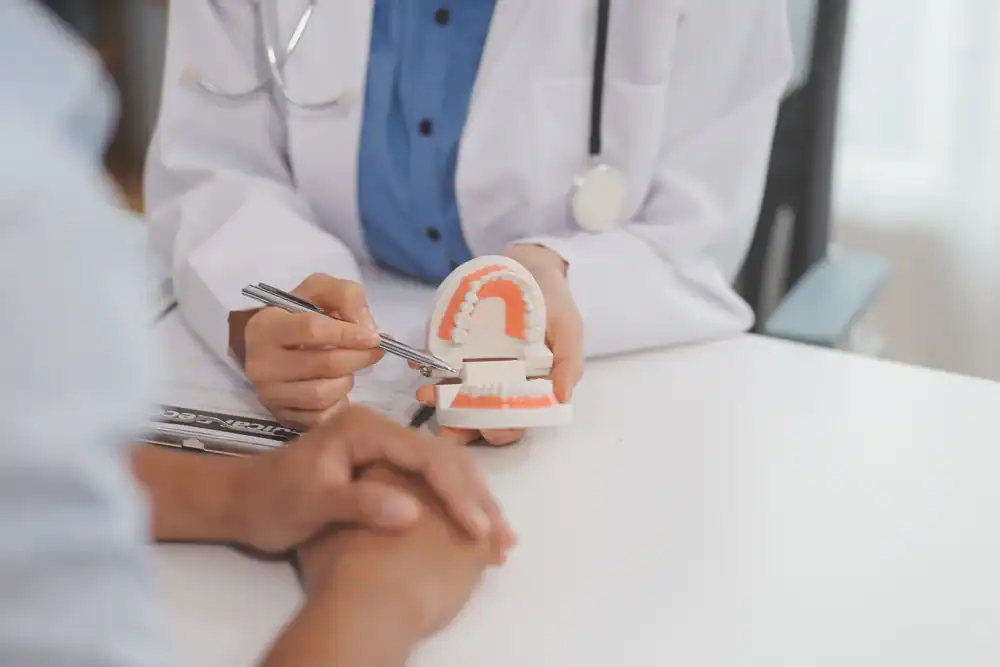
If you’re missing one tooth, a single dental implant with a crown is usually the most straightforward option. The implant goes where your natural root was, and the crown matches your surrounding teeth. It’s a clean solution that doesn’t require grinding down healthy teeth like a bridge would. We can typically complete a single implant from start to finish in three to six months.
When you’re missing several teeth or dealing with full arch problems, that’s where things get more interesting. You don’t necessarily need one implant for every missing tooth. Techniques like All-on-4 or All-on-6 use strategically placed implants to support an entire arch of teeth—meaning you could replace 10, 12, or even 14 teeth with just four to six implants.
Full arch dental implants have changed the game for people who’ve been struggling with dentures or have extensive tooth loss. Instead of dealing with adhesives and slippage, you get a fixed set of teeth that stay put. The implants are angled to maximize contact with your existing bone, which often means you can avoid bone grafting procedures that add time and cost. We’ve been using these advanced techniques to help patients in Schenectady County, NY and surrounding areas like Rotterdam and Wappingers Falls avoid the frustration of traditional dental partials.
The decision between single implants and full arch solutions usually comes down to how many teeth you’re dealing with and what condition your jawbone is in. If you’ve been wearing dentures for years, you might have some bone loss that affects your options. If you’re dealing with failing teeth, we might recommend extracting what’s left and going with a full arch solution rather than trying to save individual teeth that will likely fail later anyway.
One thing to understand: full mouth dental implants and full arch implants often get used interchangeably, but they can mean slightly different things depending on who you’re talking to. Full mouth usually refers to both upper and lower arches. Full arch means one arch—either top or bottom. When you’re getting quotes, make sure you’re clear on what’s included.
The All-on-4 concept is pretty straightforward: four implants placed at specific angles to support a full arch of teeth. Two implants go in the front where bone is typically denser, and two are angled in the back to avoid areas where bone might be thinner or where sinuses sit. This strategic placement means more people can get implants without needing bone grafts first.
All-on-6 dental implants follow the same principle but use six implants instead of four. The extra implants provide additional stability and distribute force more evenly when you’re chewing. We prefer this approach for patients with stronger bite forces or those who want maximum long-term stability.
Both options can often be done with one day dental implants—sometimes called same-day teeth or teeth in a day. You come in, have the implants placed, and leave with a temporary set of teeth the same day. These aren’t your final teeth—those come after healing—but they look natural and let you eat soft foods while you’re recovering. For a lot of people, not having to go without teeth during the healing period is a huge relief.
The healing process typically takes three to six months. During that time, the implants are fusing with your bone. You’ll come back for follow-up appointments to make sure everything is progressing as it should. Once healing is complete, your temporary teeth get replaced with your final prosthesis—either a hybrid denture or a fixed bridge, depending on what you’ve chosen.
Here’s something worth knowing: not every practice that advertises All-on-4 dental implants is offering the same thing. Some use the actual All-on-4 protocol developed by Nobel Biocare. Others use similar techniques but with different implant systems. The concept is sound either way, but the materials, planning process, and long-term support can vary. Ask what system they’re using and why they prefer it.
The cost difference between All-on-4 and All-on-6 usually comes down to those extra implants and the additional surgical time. You’re looking at roughly $5,000 to $10,000 more per arch when you add two more implants. Whether that’s worth it depends on your specific situation—bone quality, bite force, and how much security you want. Some patients also ask about 4 on 4 dental implants, which is another way of referring to the All-on-4 approach with four implants supporting a full arch.
Want live answers?
Connect with a Scott Kupetz expert for fast, friendly support.
Let’s talk about what this actually costs, because that’s probably one of your biggest questions. The full mouth dental implants cost in 2026 typically ranges from $40,000 to $70,000 for both arches. That’s a wide range, and there are real reasons for the variation.
A single tooth implant runs between $3,000 and $6,000 when you include everything—the implant post, the abutment, and the crown. If you needed to replace every tooth individually, you’d be looking at astronomical numbers. That’s why full arch solutions make more financial sense when you’re dealing with multiple missing teeth.
The average cost of dental implants per arch breaks down something like this: All-on-4 runs $18,000 to $35,000 per arch. All-on-6 is typically $25,000 to $40,000 per arch. Those numbers include the surgery, the implants, and a final prosthesis. But here’s where it gets tricky—not everyone includes the same things in their quotes.
When you’re comparing prices, you need to know what you’re comparing. Some practices quote just the implant posts. Others include everything from start to finish. The difference can be tens of thousands of dollars. You might see advertisements for cheap dental implants or low cost dental implants, but those numbers often don’t tell the full story.
A complete treatment plan should include your initial consultation and imaging, the surgical procedure to place the implants, the implants themselves, abutments that connect everything, temporary teeth if you’re getting them the same day, and your final prosthesis once healing is complete. It should also cover follow-up appointments during the healing phase.
What often gets left out of initial quotes: extractions if you still have teeth that need to come out, bone grafting if you don’t have enough bone density, sedation options if you want to be comfortable during the procedure, and the type of final prosthesis you’re getting. There’s a big cost difference between an acrylic denture and a zirconia bridge.
Material choice matters more than most people realize. Acrylic is the entry-level option—it looks good and functions well, but it can stain over time and might need replacing in 5 to 10 years. Zirconia is the premium choice. It’s incredibly strong, doesn’t stain, and can last decades. Upgrading to zirconia typically adds $4,000 to $8,000 per arch, but for a lot of people, it’s worth it for the longevity.
Geographic location affects pricing too. Dental implants in New York tend to run higher than the national average because of operating costs, staff salaries, and general cost of living. A practice in Schenectady County, NY might charge differently than one in rural upstate New York, but you’re also getting access to more experienced providers and better technology.
Provider experience is another factor. A dentist who’s been placing implants for 30 years and has done thousands of cases can typically handle complications better and get more predictable results than someone who just started offering implants. That experience has value, even if it costs a bit more upfront.
The cost of dental implants stops a lot of people from moving forward, which is why financing has become such a critical part of treatment planning. Most dental practices now work with healthcare financing companies like CareCredit, and many also offer their own in-house financing options. Understanding the affordable dental implants cost through monthly payments makes treatment accessible for more people.
CareCredit is probably the most common option you’ll see. They offer promotional periods with no interest if you pay off the balance within a set timeframe—usually 6, 12, 18, or 24 months depending on the amount. If you can pay it off during that window, you’re not paying any interest. If you can’t, the interest rate kicks in retroactively, which can be a shock. Standard rates run from about 14.90% to 17.90% APR once the promotional period ends.
In-house financing for dental implants works differently at every practice. Some offer genuine payment plans where you pay over time with no interest. Others partner with third-party lenders but handle the application in-office. The advantage is that approval requirements are often more flexible than traditional healthcare credit cards, and you’re working directly with the practice if any issues come up.
Dental implants with in-house financing can make treatment accessible even if your credit isn’t perfect. Instead of needing a 670+ credit score like most third-party lenders require, practices might approve you based on income, employment stability, and your relationship with the office. The monthly payments get built into your treatment plan from the start.
When you’re looking at payment options for dental implants, ask these questions: What’s the total amount financed? What’s the interest rate, if any? How long is the payment period? Are there penalties for early payoff? What happens if you miss a payment? And critically—what happens if you need additional work during the healing phase? You want to know if that’s covered or if it’s an additional cost.
Some practices offer financing specifically for All-on-4 dental implants because these are higher-ticket treatments. You might see 60-month payment plans for amounts over $25,000, which brings monthly payments into a more manageable range. The trade-off is that you’re paying interest for longer, so the total cost goes up. If you’re wondering about the full mouth dental implants cost cheapest option, financing can make even premium treatments manageable through extended payment terms.
Medicare dental implants coverage is something people ask about constantly, and the answer is usually disappointing. Original Medicare doesn’t cover dental implants because they’re considered dental care, not medical care. Some Medicare Advantage plans include limited dental benefits, but they rarely cover implants. You might get coverage for extractions or exams, but the implants themselves are typically out-of-pocket. This is why exploring loans for dental implants or other financing options becomes essential for many patients.
Choosing to move forward with dental implants is a big decision—financially, physically, and emotionally. But it’s also one of the few dental treatments that can genuinely change your quality of life. You’re not just fixing teeth. You’re getting back the ability to eat what you want, smile without thinking about it, and stop worrying about whether your teeth are going to embarrass you.
The key is finding a provider you trust who takes the time to explain your options, gives you transparent pricing, and has the experience to handle whatever comes up during treatment. Look for someone who’s been doing this for years, who uses modern technology, and who understands that anxiety about dental work is real and valid. Working with experienced dental professionals who specialize in implant dentistry makes all the difference in your outcome.
If you’re in Schenectady County, NY or the surrounding Capital District area—including Rotterdam, Wappingers Falls, and Dutchess County—and you’re ready to explore what dental implants could do for you, we’ve been helping patients with these exact decisions since 1988. With a Doctor of Dental Medicine degree from Fairleigh Dickinson College and more than 30 years of experience, we offer locations in both Rotterdam and Wappingers Falls, advanced technology, sedation options for anxious patients, and flexible financing including CareCredit. Whether you need a single tooth replaced or you’re looking at full mouth reconstruction, getting a consultation is the first step toward understanding what’s possible for your specific situation.
Article details:
Share:
Continue learning: