


Hear from Our Customers
Most people in Zena who are missing a tooth aren’t ignoring it because they don’t care. They’re waiting for the right time, the right information, or just enough confidence that the process won’t be miserable. That waiting period has a real cost, and it’s happening in your jaw right now. The most significant bone loss from a missing tooth occurs within the first 18 months. After that, it slows down, but it never stops. The longer the root is gone, the more the jawbone beneath it shrinks and that changes not just the structure of your mouth, but the shape of your face over time.
For residents living along County Route 30 or up on Zena Highwoods Road, this isn’t abstract. Zena skews older than almost any other community in Ulster County a median age of 58.3 means a large share of residents are at exactly the stage of life where old dental work is starting to fail. Bridges placed in the 1990s are reaching the end of their lifespan. Partial dentures that were tolerable at 50 are uncomfortable at 65. A dental implant in Zena, NY replaces the root itself not just the visible tooth which stops bone loss, preserves your facial structure, and gives you something that functions exactly like a natural tooth.
There’s also the bridge comparison worth having honestly. A bridge requires permanently grinding down the two healthy teeth on either side of the gap. Those teeth are altered forever, and the bridge itself typically lasts five to ten years before decay sets in at the margins. An implant doesn’t touch the adjacent teeth, stimulates the bone the way a natural root would, and with proper care can last decades. That’s not a small difference for someone who plans to be in Zena for the long haul.
We’ve been practicing dentistry in the Hudson Valley since 1988 well before most of the corporate dental groups that now dot the region opened their first location. Dr. Scott Kupetz earned his DMD from Fairleigh Dickinson College of Dental Medicine and has spent more than 35 years building a single-doctor practice where patients always see the same face, from the first consultation through final crown placement.
For Zena residents, that continuity matters more than it might in a bigger city. You’re already making a drive down through Woodstock, south past the Ashokan Reservoir, and on toward Wappingers Falls. The last thing you want is to arrive and find out the doctor who placed your implant has been replaced by someone you’ve never met. That doesn’t happen here. We handle every stage of the implant process in-house no referrals to outside specialists, no starting over with a new provider mid-treatment.
We also have documented availability on Sundays and after hours, which matters when you compare it to the closest local implant option in Woodstock, which is closed on weekends entirely. For a community of established adults who manage their schedules carefully, that kind of access is not a small thing.

The first step is a consultation not a sales pitch. We’ll evaluate your bone density, gum health, and the condition of the surrounding teeth to determine whether you’re a candidate and what the full treatment plan looks like. If there’s been significant bone loss which is common in Zena’s older patient population, especially for teeth that have been missing for a year or more bone grafting may be recommended before implant placement. That gets discussed upfront, not after you’ve already committed.
Once the plan is set, the titanium post is placed directly into the jawbone. This is the part most people are most anxious about, and it’s worth saying clearly: sedation options are available. Patients who have avoided dental care for years because of fear or past bad experiences can go through the entire procedure relaxed, with no white-knuckling required. After placement, there’s a healing period typically a few months during which the post integrates with the bone. This is called osseointegration, and it’s what makes the implant stable enough to function like a real root.
Once healing is complete, the final dental implant crown is placed. It’s matched to your surrounding teeth in shape and color, and from that point forward it functions exactly like a natural tooth no removal, no adhesives, no special cleaning routine beyond brushing and flossing. For Zena residents making the drive south for this procedure, the goal is to make every appointment count so you’re not making the trip more times than necessary.
Ready to get started?
Whether you’re dealing with a single missing molar, a failing bridge, or a situation where most of your teeth need to be replaced, we offer treatment options that cover the full range. A single tooth implant in Zena, NY is the most common scenario one titanium post, one crown, one solution that doesn’t compromise the teeth on either side. For patients missing multiple teeth, implant-supported bridges or partial restorations can replace several teeth without the instability of a removable appliance.
For patients dealing with full arch tooth loss or who have been wearing dentures for years and are tired of the fit issues, All-on-4 implants are worth understanding. Four strategically placed implants support a full arch of permanent teeth no removal, no adhesive, no slipping. The clinical survival rate for All-on-4 is 98.8%, and for many patients in Zena’s retiree demographic, it’s the option that finally ends a decade-long cycle of adjustments and replacements.
We offer sedation dentistry across all of these procedures. For Ulster County residents who have put off dental care because of anxiety and there are more of them than most people admit this is often the detail that makes the difference between calling and not calling. You don’t have to be braver than you feel. You just have to make one phone call, and the rest gets handled.
Zena has no dental offices of its own that’s just the reality of living in a residential hamlet within the Town of Woodstock. Every resident already travels for dental care, so the real question isn’t whether to drive, it’s whether the provider you’re driving to is worth it. For a procedure as permanent and multi-step as a dental implant, the answer depends almost entirely on who’s doing the work and whether you’ll see the same doctor at every appointment.
We’ve been practicing in the Hudson Valley for over 35 years and handle every stage of the implant process from consultation and placement to the final crown without referring you out to a separate specialist. That means fewer total appointments, one consistent relationship, and no gaps in communication between providers. For Zena residents making the trip south on Route 209 toward Wappingers Falls, that kind of continuity is exactly what makes the drive worth it.
This is one of the most common concerns among patients in Zena’s age demographic, and it’s a fair one. When a tooth has been missing for a year or more which is common for residents who have been putting off treatment the jawbone in that area has already begun to shrink. Some patients have been told by other providers that they’ve lost too much bone for an implant, and they assume that’s the end of the conversation.
It’s not. Bone grafting can rebuild the volume needed to support an implant in many cases. Our evaluation includes a thorough assessment of bone density and gum health specifically to determine what’s possible and what the realistic path forward looks like. The honest answer is that candidacy depends on your specific situation not a blanket rule about how long the tooth has been gone. The only way to know for certain is to come in and get evaluated.
A bridge replaces the visible portion of a missing tooth by crowning the two adjacent teeth and suspending a false tooth between them. To do that, those two neighboring teeth have to be ground down permanently even if they’re completely healthy. Once that’s done, it can’t be undone. The bridge itself typically holds up for five to ten years before the underlying bone loss and margin decay begin to cause problems, and at that point you’re looking at replacement.
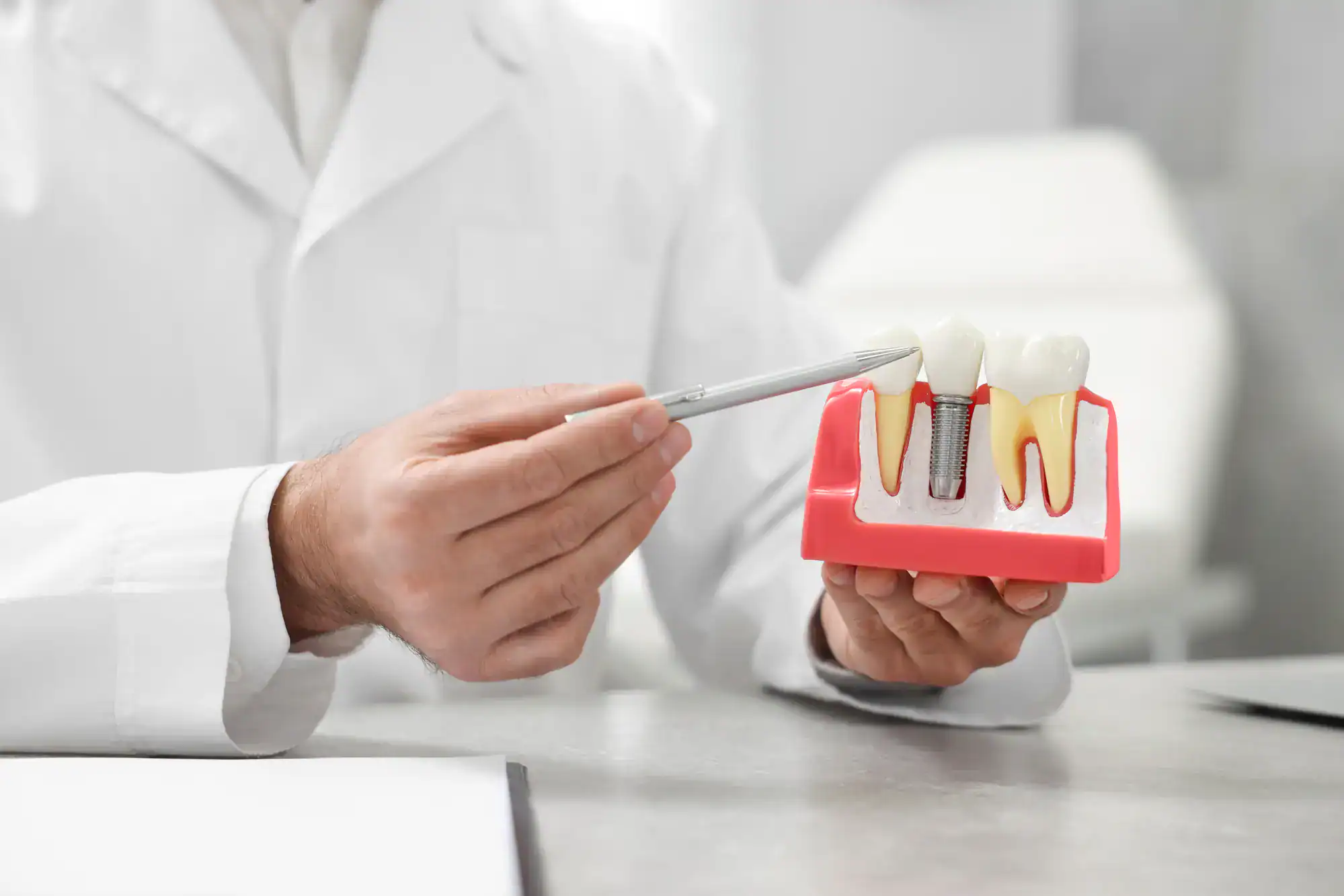
A dental implant works differently at the root level. A titanium post is placed directly into the jawbone, replacing the root rather than just the crown. That post stimulates the bone the same way a natural root does, which stops the ongoing bone loss that a bridge does nothing to address. The implant doesn’t touch the adjacent teeth at all. For someone living in Zena who plans to be here for the next twenty or thirty years, the long-term math on implants is significantly better one procedure done right versus a cycle of replacements and compromised neighboring teeth.
Yes, sedation is available, and for many patients it’s the single detail that finally moves them from “I’ll think about it” to actually scheduling. A meaningful number of adults especially those in their 50s and 60s who grew up in an era of less comfortable dentistry carry real anxiety about dental procedures. That anxiety is not irrational, and it doesn’t disqualify you from treatment.
With sedation, you’re relaxed throughout the procedure. You’re not unconscious in the way general anesthesia works, but you’re not white-knuckling the armrests either. Most patients describe it as feeling like the appointment went by quickly, with very little memory of the details. The implant placement happens, the hard part is done, and recovery begins. For Zena residents who have been avoiding dental care for years because of fear or a bad past experience, sedation dentistry isn’t a luxury add-on it’s what makes the whole thing possible.
The titanium post the part that integrates with the jawbone is designed to be permanent. With proper care, it can last decades, and in many cases it outlasts the patient. The dental implant crown on top has a more typical lifespan of ten to fifteen years before it may need to be replaced due to normal wear, but the foundation beneath it stays intact. That’s a fundamentally different longevity profile than a bridge, which typically fails within five to ten years, or a denture, which requires ongoing adjustments and periodic replacement as the jawbone continues to change shape.
For residents of Zena a community with above-average household incomes and a strong preference for quality over cheap fixes the investment framing matters. An implant costs more upfront than a bridge. But when you factor in that a bridge will likely need to be replaced at least once or twice over a twenty-year period, while also causing ongoing bone loss and compromising the adjacent teeth, the implant is frequently the more cost-effective decision over time. It’s the kind of long-term thinking that tends to resonate with homeowners who have lived in the same place for twenty years and intend to stay.
After the titanium post is placed, your body needs time to fuse with it a process called osseointegration that typically takes three to six months. During this period, you’re not in constant discomfort, but there is a healing phase in the first week or two that involves some soreness and swelling, which is normal and manageable with over-the-counter pain relief in most cases. You’ll have a temporary restoration in place so there’s no visible gap while the implant integrates.
For Zena residents dealing with the colder months and the Catskill foothills get real winters, with temperatures regularly below freezing from November through March cold-weather sensitivity around the implant site is something to be aware of in the early healing period. It typically resolves as healing progresses. We’ll walk you through exactly what to expect at each stage so you’re not guessing. The follow-up appointments are built into the process, and because everything is handled in one practice, there’s no gap between the surgeon who placed the implant and the doctor managing your recovery it’s the same person throughout.
Other Services we provide in Zena