


Hear from Our Customers

A missing tooth is rarely just a cosmetic issue. The moment a tooth is gone, the jawbone underneath it starts to shrink quietly, steadily, and permanently. Most of the significant bone loss happens within the first 18 months, but it doesn’t stop there. Over time, that bone loss changes the shape of your face, weakens surrounding teeth, and makes future treatment more complicated and more expensive. Getting a dental implant in Stanford, NY isn’t just about filling a gap it’s about stopping a process that doesn’t reverse on its own.
For Stanford residents, where getting to a specialist already takes planning, the last thing you want is a solution that fails in five to ten years and sends you back to square one. A bridge might seem like the simpler path, but it requires permanently grinding down the two healthy teeth on either side and it still doesn’t stop bone loss. A dental implant, by contrast, functions like a natural root. It integrates with your jawbone, holds its position for decades, and doesn’t ask anything of the teeth next to it.
The median age in this part of Dutchess County sits around 51 which means a significant share of residents are right in the window where tooth loss, bone deterioration, and denture dissatisfaction tend to peak. If you’ve been managing with a gap, a bridge that’s starting to fail, or dentures that never quite fit right, the longer you wait, the narrower your options become.
We’ve been practicing in the Hudson Valley since 1988 long before corporate dental chains started opening locations across Dutchess County. Dr. Scott Kupetz graduated from Fairleigh Dickinson College of Dental Medicine and has spent his entire career serving patients across north-central Dutchess County, including communities like Stanford, Stanfordville, Bangall, Millbrook, and Pine Plains. When you come in for dental implants near Stanford, NY, you’re seeing the same doctor at every appointment not a rotating associate, not whoever’s available that day.
That consistency matters more than people realize, especially for a multi-step procedure like implant placement. We handle everything from the initial consultation through the final crown, all under one roof. No referrals to a separate oral surgeon. No driving to three different offices across the county. For residents who already have to travel for most specialty care, that simplicity isn’t a small thing it’s the whole point.

It starts with a consultation where we evaluate your jawbone density, gum health, and overall oral condition. If there’s been significant bone loss which is common when a tooth has been missing for a year or more a bone graft may be recommended before implant placement. This isn’t a setback; it’s a necessary step that sets the implant up for long-term success. For many Stanford residents who’ve been putting off treatment for a while, this is exactly where the process begins.
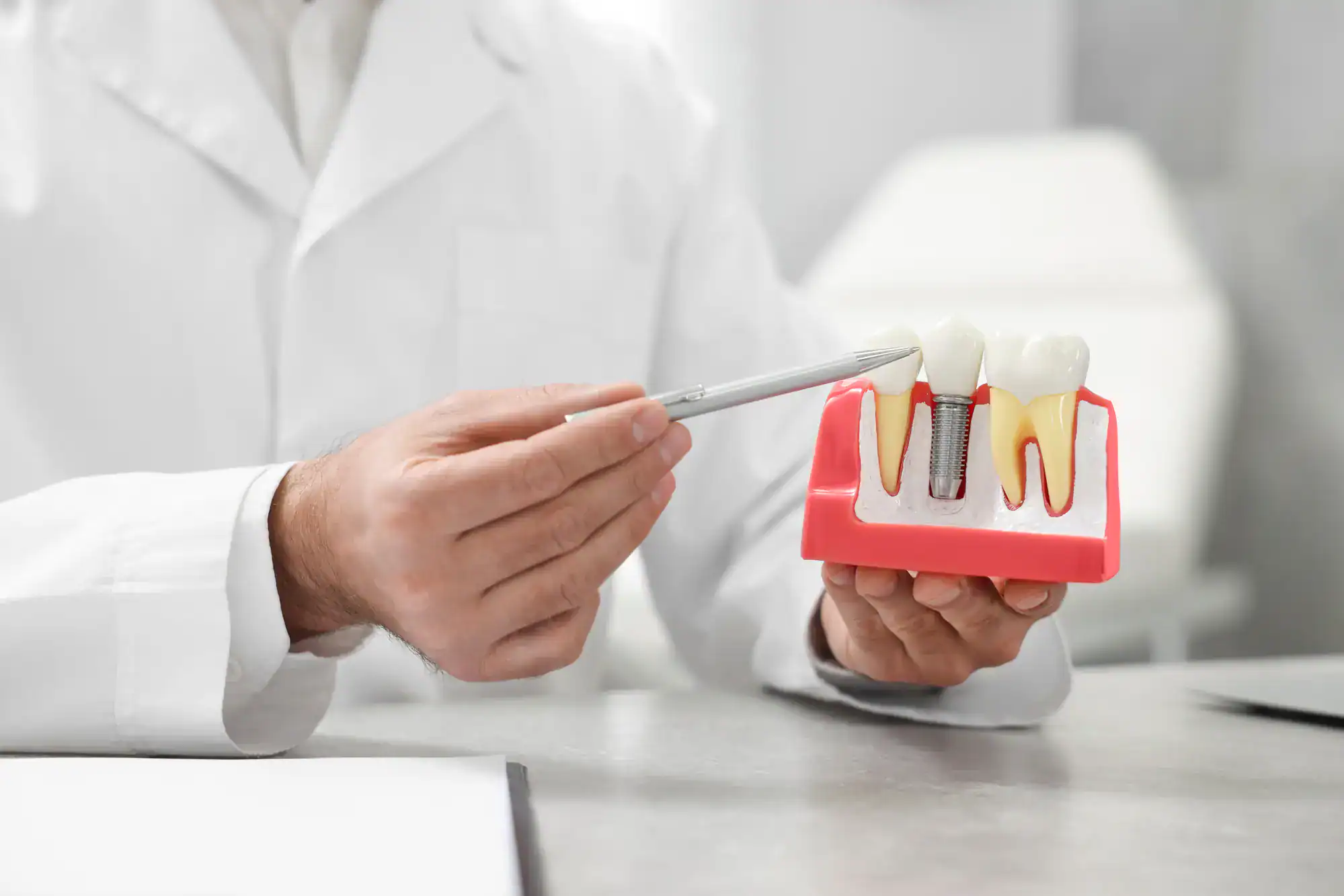
Once your jawbone is ready, a small titanium post is placed into the socket where the tooth root used to be. Over the next few months, that post fuses with the bone in a process called osseointegration your body essentially accepts it as part of the jaw. During this healing phase, we monitor your progress and prepare for the final step: attaching the permanent crown that looks and functions like a natural tooth.
From first appointment to final crown, the full process typically takes a few months, depending on whether bone grafting is needed and how quickly your body heals. Every step happens at one location, with one doctor who already knows your case. For anyone coming in from Stanford or nearby, that means fewer trips, no handoffs, and a clear picture of what’s happening and why at every stage.
Ready to get started?
Not every missing tooth situation looks the same, and the right implant solution depends on how many teeth are missing, how long they’ve been gone, and what the current state of your jawbone looks like. For a single missing tooth whether it’s a molar, a front tooth, or something that was knocked out in an accident a single-tooth implant with a permanent crown is usually the most straightforward and longest-lasting option. Molar implants in Stanford, NY are among the most common requests, since back teeth take the most pressure and tend to fail or get extracted first.
If you’re dealing with multiple missing teeth or have been wearing dentures that no longer fit well, implant-supported dentures or an All-on-4 implant procedure may be a better fit. These options anchor a full arch of teeth to a small number of strategically placed implants eliminating the slipping, the adhesive, and the bone loss that comes with traditional removable dentures. For Stanford residents who work physical jobs on farms or equestrian properties, having teeth that stay in place without worry is a practical benefit, not just a cosmetic one.
We offer sedation dentistry for patients who have significant dental anxiety which is common among people who’ve been avoiding the dentist for years. If that’s you, it’s worth knowing that sedation is a standard part of what we offer, not an add-on that requires a separate appointment or referral. Same-day and after-hours emergency appointments are also available, including Sundays, for patients dealing with acute dental pain or a broken restoration that can’t wait until Monday.

A dental implant, when properly placed and cared for, is designed to last the rest of your life. The titanium post that integrates with your jawbone doesn’t decay, and with normal brushing, flossing, and routine checkups, the implant itself rarely needs to be replaced. The crown on top may eventually need attention after 15 to 25 years, but that’s a straightforward fix compared to starting over entirely.
A dental bridge, by contrast, typically lasts 5 to 10 years before it begins to fail and when it does, the two healthy teeth it was anchored to have already been permanently altered. You’re then looking at replacing the bridge, managing those compromised anchor teeth, and still dealing with the ongoing bone loss underneath the gap that the bridge never addressed. Over a 20- or 30-year window, a single implant almost always costs less and causes fewer problems than a series of bridge replacements. For Stanford residents who want to make one decision and move on, the math tends to favor the implant.
Most patients are surprised by how manageable the process is. The implant placement itself is done under local anesthesia, so you won’t feel the procedure while it’s happening. Afterward, there’s typically some soreness and swelling for a few days similar to what you’d experience after a tooth extraction and over-the-counter pain relievers are usually enough to stay comfortable.
The longer part of the process is healing, not pain. After the titanium post is placed, your body needs several months to fuse with it before the permanent crown goes on. During that time, most people go about their normal lives without significant discomfort. For patients with dental anxiety who are worried about the procedure itself, we offer sedation options including options that let you remain conscious but deeply relaxed throughout. If you’ve been avoiding this because you’re expecting it to be painful, the reality is usually much less intense than people anticipate.
Yes, in most cases. Bone loss after tooth extraction is extremely common, especially if the tooth has been missing for a year or more. The most significant deterioration happens in the first 18 months, but it continues gradually over time. Many Stanford residents come in for a consultation assuming that window has closed it usually hasn’t.
When bone density is insufficient to support an implant directly, a bone graft is performed first. This adds bone material to the area, allows it to integrate over a few months, and creates a stable foundation for the implant post. It adds time to the overall process, but it’s a well-established procedure with a strong track record. We evaluate bone density at the initial consultation using imaging, so you’ll know exactly where you stand and what the realistic path forward looks like before committing to anything.
A single dental implant including the post, abutment, and crown typically ranges from $3,000 to $5,000 depending on the complexity of the case and whether preparatory work like bone grafting is needed. If you’re replacing multiple teeth or considering implant-supported dentures, the total investment will be higher, though the per-tooth cost often comes down with larger cases.
That number can feel significant upfront, but it’s worth comparing it to the alternative. A dental bridge costs less initially but typically needs to be replaced every 5 to 10 years and each replacement comes with its own costs and complications. Over 20 years, a bridge often ends up costing more than an implant, while also causing more problems along the way. We offer financing options through CareCredit and similar programs, which allow you to spread the cost over time without delaying treatment. For Stanford residents who don’t have employer-sponsored dental coverage, this is often the most practical way to move forward.
Stanford itself doesn’t have a dental office residents have traditionally traveled to Millbrook, Rhinebeck, Amenia, or further south toward Poughkeepsie for specialty care. Our practice in Wappinger Falls is accessible via Route 82 south, a route many Stanford residents already use for regional services. The drive is roughly 15 minutes from central Stanford, making it one of the closest implant options available.
What makes the trip worthwhile is that you’re not going to a general dentist who occasionally places implants you’re seeing a provider with over 35 years of Hudson Valley experience who handles the full implant process from evaluation to final crown, without sending you somewhere else for any part of it. We stay local to the area we serve, which means we understand the needs and lifestyles of Stanford residents specifically.
It depends on the current state of your jawbone, but in many cases, yes. Long-term denture wearers often experience significant bone loss over time because dentures sit on top of the gum tissue and don’t stimulate the underlying bone the way natural teeth or implants do. The longer you’ve worn dentures, the more bone may have resorbed, which is why getting evaluated sooner rather than later matters.
For patients who want to move away from removable dentures entirely, implant-supported dentures or an All-on-4 procedure can be a life-changing alternative. These options anchor a full arch of replacement teeth to a small number of implants, giving you teeth that stay in place, function like natural teeth, and stop the ongoing bone loss that removable dentures can’t address. For Stanford residents in their 50s and 60s who’ve been managing with ill-fitting dentures for years and who work physical, active lives on farms or equestrian properties in the area this kind of stability makes a real practical difference. A consultation with us will include imaging to assess your current bone levels and give you an honest picture of what’s possible.
Other Services we provide in Stanford