


Hear from Our Customers
When a tooth is missing, the jawbone underneath it starts to shrink. Not eventually within the first 18 months. For Lake Katrine residents, where the median age sits above 55 and a third of the community is 65 or older, that’s not a distant risk. It’s likely already happening. A titanium post tooth replacement in Lake Katrine, NY is the only option that stops that process because the implant acts as an artificial root and keeps the bone stimulated the same way a natural tooth would.
The difference in daily life is real. You chew without shifting. You speak without hesitation. You stop avoiding certain foods or feeling self-conscious at a family dinner. For a community that gathers around places like Adams Fairacre Farms on Ulster Avenue, where meals and social connection are part of everyday life, that matters more than it sounds.
Unlike a bridge which requires permanently grinding down the two healthy teeth on either side just to anchor it a dental implant crown in Lake Katrine, NY leaves your surrounding teeth completely untouched. Bridges also don’t stimulate the jawbone, so bone loss continues underneath them. They typically need replacement within five to ten years. An implant, maintained properly, can last the rest of your life.
Dr. Scott Kupetz has been practicing dentistry in the Hudson Valley since 1988 a year before many of his current patients’ kids started school at E.R. Crosby Elementary down on Neighborhood Road in Lake Katrine. That kind of tenure isn’t a marketing line. It means we’ve seen what happens when patients wait, when bone loss goes unchecked, and when the wrong solution gets chosen because no one took the time to explain the difference.
Our practice handles everything consultation, implant placement, and the final dental implant crown under one roof, with one doctor who knows your history. You’re not getting handed off to a periodontist in Kingston or bounced between providers you’ve never met. For Lake Katrine residents who’ve dealt with that kind of fragmented care before, that consistency is the whole point.
We also offer sedation for patients who have been putting off treatment because of anxiety. If you’ve been avoiding the dentist for years and a lot of people in this area have that’s not a judgment. It’s just something we’re equipped to help with.
It starts with a consultation. We review your X-rays, evaluate your bone density, and tell you directly whether you’re a candidate and if bone loss has been an issue, whether a bone graft is needed before placement. A lot of older patients in the Lake Katrine area assume years of missing teeth automatically disqualify them. That’s often not true anymore. Modern techniques and bone grafting have expanded who qualifies significantly, and the only way to know your situation is to actually have it evaluated.
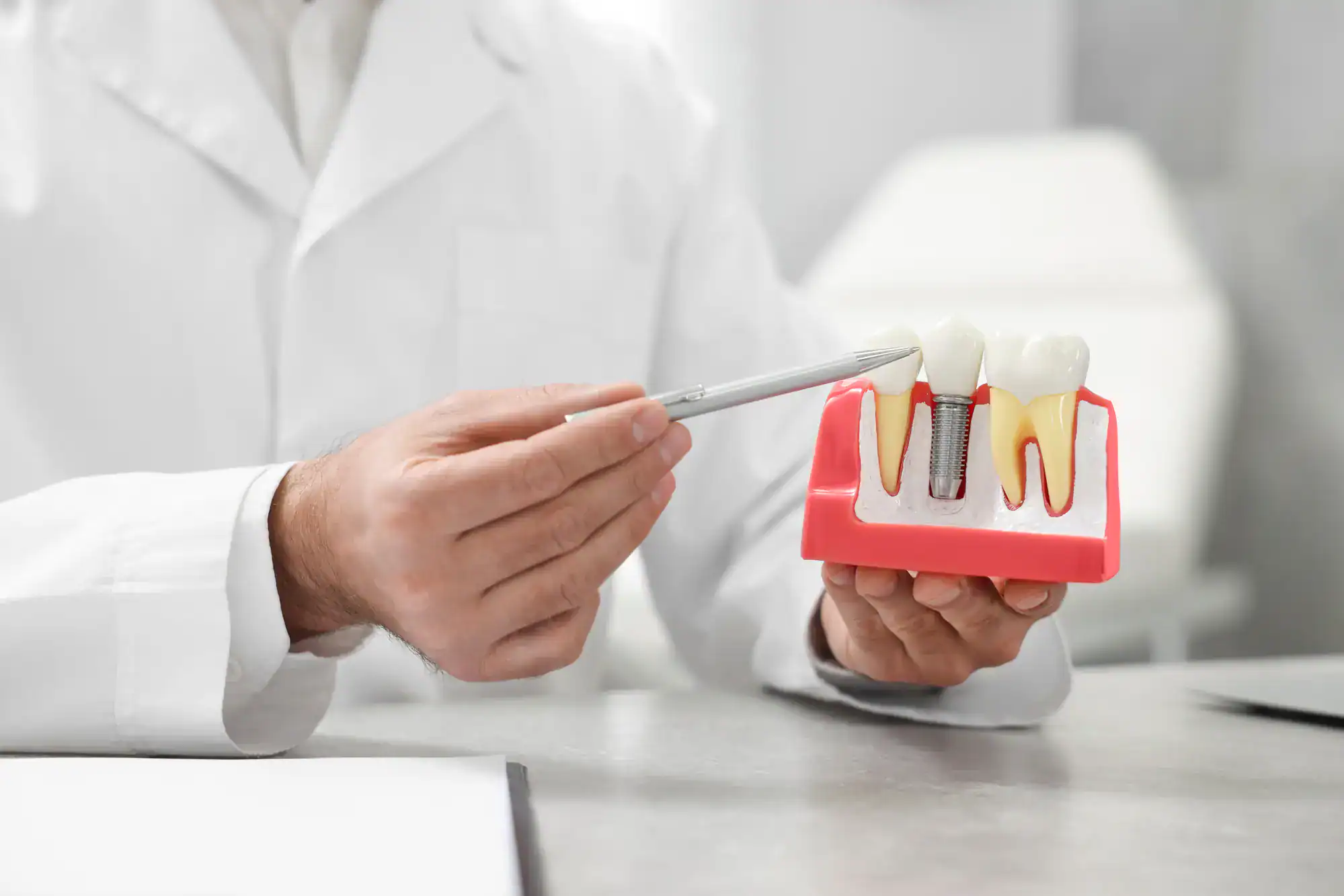
If you’re a candidate, the titanium post is placed into the jawbone during a straightforward in-office procedure. Sedation is available if you want it. The post then integrates with the bone over the next few months a process called osseointegration and once that’s stable, the abutment and final crown are placed on top. The result looks, feels, and functions like a natural tooth.
The whole timeline typically runs three to six months from placement to crown, depending on healing. There’s no need to coordinate between multiple offices or navigate referrals across the Kingston area. Every step happens with us, in one location, on a schedule that works for you including after-hours and weekend availability for patients who can’t always make a standard weekday appointment.
Ready to get started?
The most common tooth lost in adults over 50 is a molar. Molars carry the majority of your chewing load, and when one goes missing usually to decay or gum disease the remaining teeth pick up the slack in ways they weren’t designed to handle. A molar implant in Lake Katrine, NY restores that function directly, prevents adjacent teeth from shifting into the gap, and keeps the jawbone stimulated at exactly the point where it matters most. Leaving a missing molar unaddressed is one of the most costly dental decisions you can make over the long run.
For patients missing a single front or mid-mouth tooth, a single tooth implant versus bridge comparison almost always favors the implant not because bridges can’t work, but because they require permanently altering healthy teeth and don’t address the underlying bone loss. A dental implant crown in Lake Katrine, NY preserves everything around it and gives you a restoration that behaves like a natural tooth.
For patients who are further along wearing full or partial dentures, or missing most of their teeth we also offer implant-supported options like All-on-4. These replace an entire arch with a fixed, non-removable set of teeth anchored by four implants. The success rate for All-on-4 sits above 98%, and for Lake Katrine residents who have been living with loose or uncomfortable dentures, the difference in daily function is significant. We offer financing options, and our team will walk you through cost and coverage before you commit to anything.
A single dental implant in Lake Katrine, NY including the titanium post, abutment, and crown typically runs between $3,000 and $5,000. That range can shift depending on whether you need a bone graft beforehand, which tooth is being replaced, and what your insurance covers. Most standard dental insurance plans don’t cover implants fully, but many cover portions of the process the extraction, the crown, or the diagnostic work which can reduce your out-of-pocket cost meaningfully.
The more useful way to think about cost is over time. A bridge in the same price range will likely need replacement within a decade and doesn’t stop the bone loss underneath it, which can create more expensive problems down the road. An implant, maintained with normal brushing and regular checkups, is designed to last the rest of your life. For Lake Katrine residents on a fixed or moderate income, that long-term math matters. We offer financing options, and our team will give you a clear picture of costs before any treatment begins no surprises.
Possibly, yes and more often than people expect. Bone loss after tooth loss is common, especially for older adults in Lake Katrine who may have been missing teeth for a decade or more. The assumption that long-standing bone loss automatically disqualifies you from implants is outdated. Bone grafting procedures can rebuild the jawbone in areas where it has deteriorated, creating a stable foundation for the implant post. Sinus lifts are also available for upper back teeth where bone height is often reduced.
Whether grafting is needed and how much depends entirely on your specific situation. We evaluate bone density directly during your consultation using imaging, so you get a real answer based on your jaw, not a general assumption. If you’ve been told in the past that you’re not a candidate, it’s worth getting a second opinion. The field has changed, the techniques have improved, and what wasn’t possible ten years ago often is today.
The core difference comes down to what happens to the teeth around the gap and what happens to the bone underneath it. A fixed bridge works by crowning the two healthy teeth on either side of the missing tooth and suspending a false tooth between them. To do that, those adjacent teeth have to be permanently ground down reshaped to accept the crowns. That’s irreversible, and it puts those teeth at higher risk of decay and nerve damage over time.
An implant doesn’t touch the neighboring teeth at all. The titanium post goes directly into the jawbone, the abutment connects to it, and the crown sits on top completely self-contained. It also stimulates the jawbone the way a natural tooth root does, which stops the bone from shrinking. Bridges don’t do that. For Lake Katrine residents in their 50s and 60s who still have healthy teeth surrounding the gap, protecting those teeth is a real long-term consideration. A single tooth implant versus bridge comparison almost always favors the implant when adjacent teeth are healthy and bone is sufficient for placement.
Yes, we offer sedation. For a lot of patients particularly older adults in the Lake Katrine area who have been avoiding dental care for years this is the detail that actually makes the difference between calling and not calling. Dental anxiety is common, and it tends to build over time. The longer someone has put off treatment, the more complicated their situation usually is, and the more anxious they feel about addressing it. It becomes a cycle.
We’ve been working with anxious patients for over 35 years. Sedation for implant procedures means you’re relaxed and comfortable throughout most patients remember very little of the procedure itself. You’ll need someone to drive you home afterward, so it’s worth planning for that. But for patients who have been carrying around a missing tooth or a deteriorating dental situation because they couldn’t face the appointment, sedation changes what’s possible. The first step is just a consultation, and that part doesn’t require sedation at all it’s just a conversation about where you are and what your options look like.
The full process from implant placement to final crown typically takes three to six months, and sometimes a bit longer if a bone graft is needed before the post can be placed. The reason it takes that long isn’t the procedures themselves, which are straightforward. It’s the healing time between them. After the titanium post is placed, the bone needs to fuse around it a process called osseointegration before the abutment and crown can be added on top. Rushing that phase compromises the stability of the whole implant.
For Lake Katrine residents with busy schedules, the good news is that most of that time is passive you’re healing at home, not sitting in a dental chair. The number of actual appointments is relatively small: consultation, placement, a follow-up or two during healing, and then the crown appointment. We also offer after-hours and weekend availability, which makes scheduling easier for patients who can’t always get away during the week. The timeline feels long in the abstract, but most patients find it more manageable than they expected once they’re in it.
The jawbone in the area of a missing tooth starts to resorb essentially, it shrinks because there’s no longer a root stimulating it. The most significant loss happens in the first 18 months, but the process doesn’t stop there. Over years, that bone loss changes the shape of your jaw, causes neighboring teeth to drift and tilt into the gap, and can create bite problems that affect teeth far from the original missing one. For older adults in Lake Katrine where more than a third of residents are 65 or older this isn’t a theoretical risk. It’s an active process for a large portion of the community.
The practical consequences compound over time. Shifting teeth are harder to clean, which increases decay risk. A shrinking jawbone makes future implant placement more complicated and sometimes requires grafting that wouldn’t have been needed earlier. And if you’re wearing a partial denture over the area, it will fit less and less well as the bone changes shape beneath it. Tooth loss and bone loss are directly connected, and the window to address it most simply is earlier rather than later. A consultation costs nothing but time, and it gives you a clear picture of where things actually stand.
Other Services we provide in Lake Katrine