

Hear from Our Customers

A dental implant isn’t just about how your smile looks. It’s about stopping a process that’s already in motion. When a tooth is lost, the jawbone underneath starts to shrink and the most significant deterioration happens within the first 18 months. After that, it keeps going. Quietly. For years. Many Glasco residents who’ve been living with a missing tooth have no idea that the bone beneath it is already changing shape.
For a community where more than 20% of residents are 65 or older, that’s not a minor concern. It’s the difference between a straightforward implant procedure now and a much more complex, expensive one later. Getting ahead of it means preserving the bone, keeping neighboring teeth in place, and avoiding the facial changes the sunken jaw, the shifting bite that come with long-term tooth loss.
On a practical level, an implant works like a real tooth. You eat what you want. You don’t take it out at night. You don’t adjust it every few years. For Glasco residents who work hard and don’t have time for repeated dental appointments and adjustments, that kind of permanence matters. One solid solution beats a patch job every time.
Dr. Scott Kupetz has been practicing dentistry in the Hudson Valley since 1988 before most of Glasco’s current residents were raising families or dropping kids off at local schools. He graduated from Fairleigh Dickinson College of Dental Medicine and has spent his entire career serving patients across Ulster and Dutchess counties. That’s not a marketing line. That’s just the timeline.
This is a single-doctor practice. When you come in for a consultation, you see Dr. Kupetz. When you come back for the procedure, you see Dr. Kupetz. No rotating associates, no hand-offs, no starting the trust-building process over with someone new. For a community like Glasco where people value continuity and know who they’re working with that matters more than any piece of equipment or office renovation.
We also offer sedation dentistry for patients who’ve been putting off care because of anxiety. If that’s you, you’re not alone, and there’s no judgment here.
We regularly see patients from Stone Ridge and Malden-on-Hudson. Patients from Shorehaven and Lloyd also make the trip to our practice, knowing they’ll always see the same experienced doctor from start to finish.

Most patients who look into dental implants assume the process involves multiple providers a general dentist for the consultation, an oral surgeon for the post, someone else for the crown. That’s how it works at a lot of practices. It’s not how it works here. Dr. Kupetz handles the full process in one location, from the initial exam through the final restoration. For Glasco residents who are already making a drive to access dental care, that’s not a small thing.
It starts with a consultation where Dr. Kupetz evaluates your bone density, your overall oral health, and whether an implant is the right call for your specific situation. If you’ve had a missing tooth for a while, bone grafting may be part of the conversation that’s a normal part of the process for patients who’ve been waiting, and it’s handled in the same office. From there, the titanium post is placed into the jawbone, a healing period follows, and the final implant crown is attached once everything has integrated properly.
The whole process typically spans a few months, but most of that time is your body doing the work. The number of actual appointments is manageable. And because everything happens with the same doctor in the same place, nothing gets lost in translation between providers.
Patients from Plattekill, North East, Washington, and Esopus all go through this same straightforward, single-provider process with Dr. Kupetz.
Ready to get started?
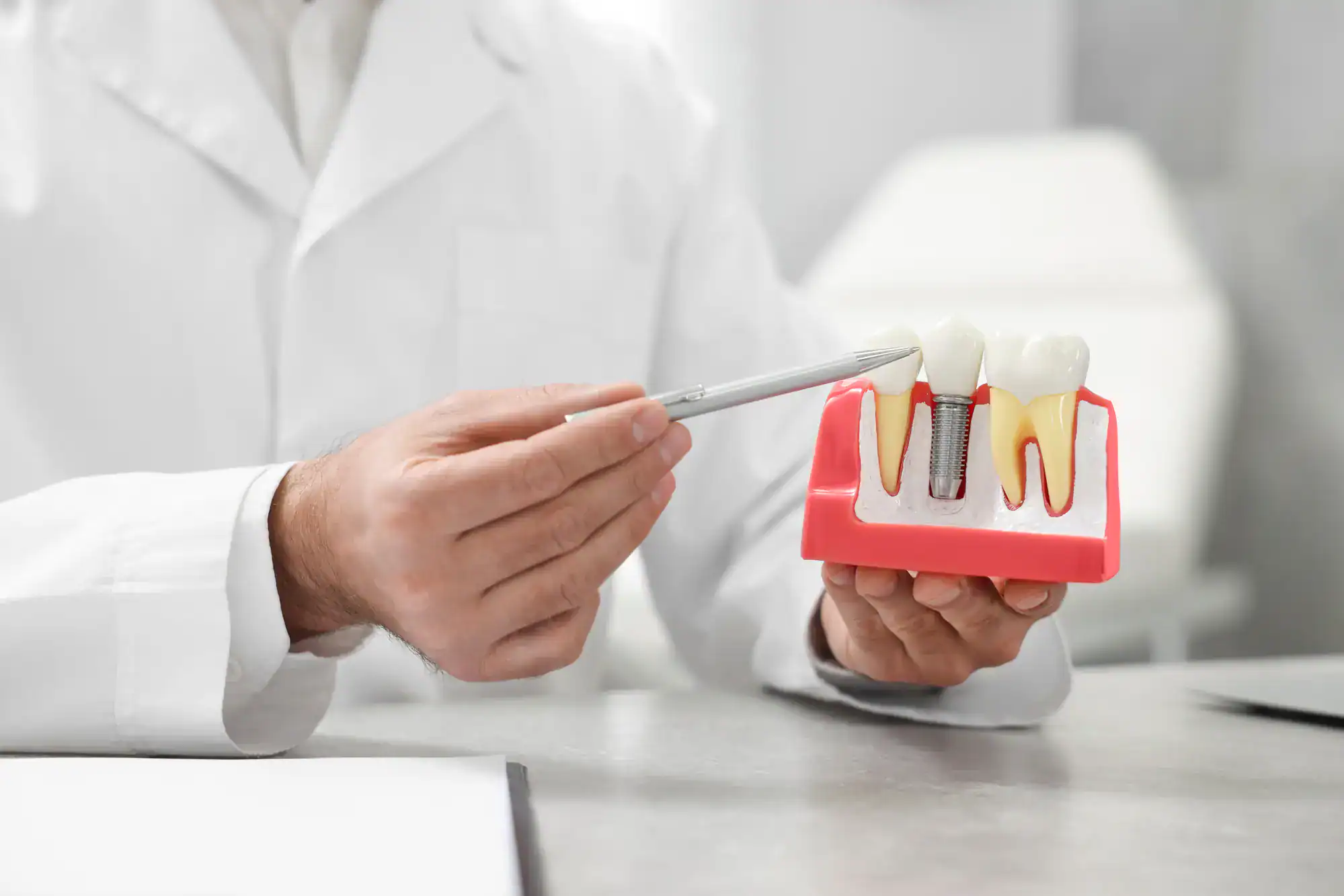
A dental implant has three parts: the titanium post that goes into the jawbone and acts as the root, the abutment that connects the post to the visible portion, and the implant crown that sits on top and looks like a natural tooth. Together, they function as close to a real tooth as dentistry currently offers. The titanium post fuses with your bone over time a process called osseointegration which is what gives implants their stability and longevity. A well-placed implant can last the rest of your life.
For Glasco patients who’ve been considering a bridge instead, it’s worth understanding the difference. A bridge fills the gap, but it requires grinding down the two healthy teeth on either side of it to anchor the restoration. You’re permanently altering teeth that weren’t the problem. And a bridge doesn’t stop bone loss the jawbone beneath the gap continues to shrink because there’s no root stimulating it. An implant does. That’s the functional distinction that most people don’t hear until they’re already committed to the wrong option.
If you’re missing multiple teeth or have been wearing a partial denture, implants can also be used to support a more stable, fixed restoration. The right approach depends on your specific situation, which is why the consultation is the starting point not a sales pitch, just an honest look at what you’re working with and what will actually serve you long-term.
This honest, practical approach is why patients from Cragsmoor, Titusville, Shokan, and Preston-Potter Hollow choose to make the trip to our Ulster County practice.
Bone loss is one of the most common reasons people assume they can’t get implants and it’s also one of the most common misconceptions. The reality is that many patients with some degree of bone loss are still candidates for implants, often with the addition of a bone graft performed before or during the implant procedure. The graft rebuilds the foundation so the titanium post has enough structure to anchor into properly.
In Glasco, where the median age is over 52 and a significant portion of residents are 65 or older, it’s not unusual for patients to come in having lived with a missing tooth for years sometimes a decade or more. That timeline almost always means some bone loss has occurred. It doesn’t automatically disqualify you. What it does mean is that the consultation needs to include a thorough evaluation of your bone density, usually with imaging, so Dr. Kupetz can give you an honest picture of what the process looks like for your specific situation. The earlier you come in, the more options you have.
A single dental implant including the post, abutment, and implant crown typically ranges from $3,000 to $5,000 depending on the complexity of the case, whether bone grafting is needed, and the location of the tooth being replaced. That’s a real number, and it’s worth being honest about upfront rather than burying it.
What’s also worth understanding is the long-term math. A dental bridge might cost less initially, but it typically needs to be replaced every 5 to 10 years and each replacement involves the same costs again, plus the continued bone loss happening underneath it. An implant, done well, can last the rest of your life. For Glasco residents who are price-conscious and value getting things done right the first time, that comparison matters. We offer financing options to help spread the cost, and the consultation is the right time to talk through what fits your situation. No pressure, just a real conversation.
The most important distinction isn’t the cost it’s what each option does to the teeth around the gap. A dental bridge uses the two teeth adjacent to the missing tooth as anchors. To do that, those teeth have to be filed down significantly so the bridge can be cemented over them. Those are healthy teeth that weren’t the problem, and once they’re reduced, that’s permanent. You’ve traded one issue for a change that affects three teeth instead of one.
An implant replaces only the missing tooth. The neighboring teeth stay completely untouched. Beyond that, the implant’s titanium post stimulates the jawbone the way a natural root does, which prevents the bone loss that continues under a bridge. For Glasco residents in their 50s and 60s who are already dealing with the long-term effects of a missing tooth, stopping that bone deterioration is as important as filling the visible gap. A bridge addresses the appearance. An implant addresses the underlying biology.
The procedure itself is done under local anesthesia, so you shouldn’t feel pain during the placement. Most patients report that the discomfort afterward typically some soreness and swelling for a few days is milder than they expected. It’s generally described as less uncomfortable than a tooth extraction.
For patients who carry significant anxiety about dental procedures, we offer sedation dentistry. This is relevant for a lot of Glasco residents who’ve been avoiding dental care for years sometimes because of a bad experience, sometimes because of cost, sometimes just because of fear. Sedation doesn’t mean you’re put under general anesthesia. It means you’re relaxed, comfortable, and largely unaware of what’s happening during the procedure. You’re still responsive, but the experience is completely different from sitting in the chair white-knuckling it. If anxiety has been the thing standing between you and getting this handled, it’s worth asking about sedation at your consultation. It changes the experience significantly.
The full process from the initial consultation to the final implant crown being placed typically takes anywhere from three to six months, sometimes longer if bone grafting is needed beforehand. That timeline might sound like a lot, but most of it is healing time, not appointment time. The actual number of visits is manageable, and the gaps between them are your body doing the integration work.
For Glasco residents who commute for work, the scheduling reality matters. The appointments are spaced out enough that they don’t stack up the way a multi-appointment specialist referral chain would. And because Dr. Kupetz handles the entire process from post placement through the final crown in one location, you’re not coordinating between multiple offices or re-explaining your history to a new provider at each stage. The process is straightforward when it’s managed by one doctor who knows your case from day one.
Yes, we offer sedation dentistry for implant procedures. For patients in and around Glasco who’ve been putting off dental care sometimes for years the availability of sedation is often the detail that finally makes the appointment feel possible.
Glasco is a community with deep working-class roots, and dental avoidance is genuinely common in communities like this one. It’s not weakness. It’s a combination of cost anxiety, past experiences, and the way fear compounds over time when you keep pushing something off. Sedation removes the physical and psychological barrier of sitting through a procedure you’re dreading. You’re relaxed, the time passes quickly, and the experience is far removed from what most anxious patients imagine beforehand. If you’ve been telling yourself you’ll deal with it eventually, sedation is worth asking about it’s one of the more practical reasons patients who’ve waited years finally follow through and get it done.
Other Services we provide in Glasco