


Hear from Our Customers
When a tooth is gone, the bone underneath it starts to shrink. Not eventually now. Within the first 18 months after an extraction, the jaw loses the most volume it ever will. For Westmere residents who’ve been told to “come back when you’re ready,” that waiting period has real consequences that quietly narrow your options over time.
A dental implant replaces the root itself not just the visible tooth. That means your jawbone gets the stimulation it needs to stay intact, your surrounding teeth stay in place, and your face keeps its natural structure. For Westmere’s established homeowners and working professionals who want a fix that doesn’t require maintenance every few years, that permanence matters. You’re not patching a gap you’re rebuilding the foundation.
The sooner a missing tooth is addressed, the less complicated the path forward becomes. A single implant placed today is a far simpler procedure than a bone graft plus implant two years from now and the difference between those two scenarios often comes down to how long someone waited to make the call.
Dr. Scott Kupetz has been practicing dentistry since 1988 that’s over 35 years of clinical experience placing implants, restoring smiles, and actually knowing his patients by name. He graduated from Fairleigh Dickinson College of Dental Medicine and has spent decades serving patients across the Hudson Valley and Albany County, including the Westmere and Guilderland communities.
This isn’t a group practice where you see whoever’s available. When you come in for a consultation, you see Dr. Kupetz. When your implant is placed, that’s Dr. Kupetz too. And when your final crown is seated, same doctor, same relationship, same standard of care. For patients in Westmere who’ve bounced around multi-provider offices or felt like just another chart number at a corporate dental chain, that consistency is something different.
We also offer sedation for patients who need it because anxiety shouldn’t be the reason someone keeps living with a gap in their smile.
It starts with a consultation. Not a sales pitch an actual clinical conversation where Dr. Kupetz looks at your bone structure, reviews your health history, and tells you honestly what your options are. If you’ve been told before that you’re not a candidate due to bone loss or a health condition, that conversation is worth having again. The field has changed, and what disqualified someone years ago often doesn’t today.
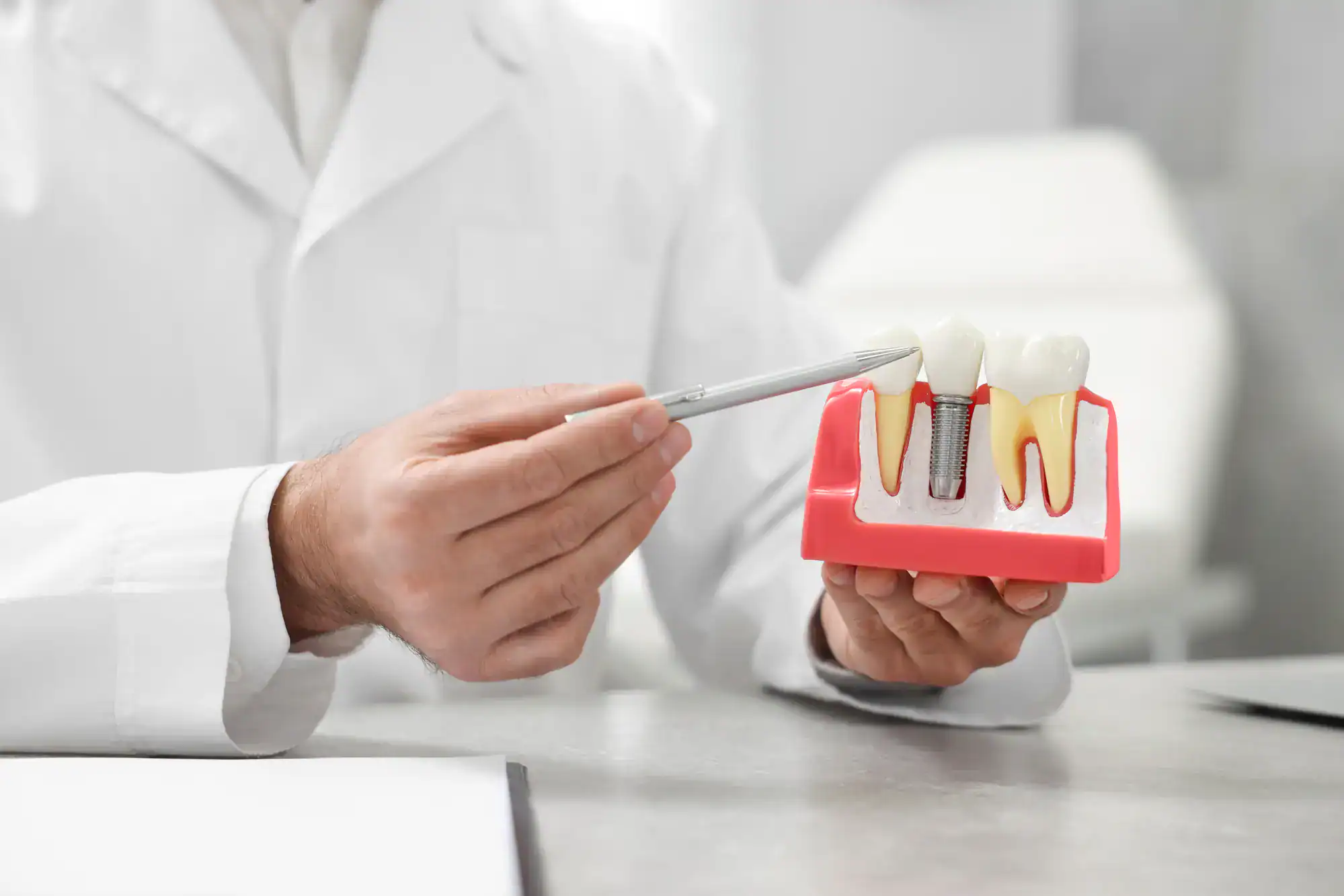
If implants are the right move, the process begins with placing a small titanium post into the jawbone where the missing tooth root used to be. That post integrates with the bone over a healing period typically a few months before an abutment and custom crown are attached on top. The result looks, feels, and functions like a natural tooth. For patients replacing a molar, a single front tooth, or exploring implant-supported dentures for multiple missing teeth, the process is adapted to fit the specific case.
Everything happens under one roof. You won’t be referred out to an oral surgeon you’ve never met or sent to a separate office for the crown. That matters practically fewer appointments, less coordination but it also matters because continuity of care during a multi-step procedure like this is how good outcomes happen. For Westmere residents managing busy schedules between work, family, and daily life, that kind of efficiency is real.
Ready to get started?
Whether you’re missing one tooth or several, we offer implant options that cover the full range of what most patients in Westmere and the surrounding area actually need. Single-tooth implants a titanium post, abutment, and crown are the most common case and the most straightforward. If you’ve lost a molar to decay or injury, that’s typically a strong candidate for a single implant, and the result is indistinguishable from the original tooth in both function and appearance.
For patients who’ve been wearing a partial or full denture and are ready for something that doesn’t move, we also provide implant-supported dentures and All-on-4 full-arch restorations. All-on-4 uses four strategically placed implants to anchor a full arch of teeth permanently no adhesives, no slipping, no removing them at night. Clinical data puts the survival rate for All-on-4 at 98.8%, which makes it one of the most reliable restorative procedures in dentistry.
One thing worth knowing before you compare options: a fixed bridge might sound simpler, but it requires permanently grinding down the two healthy teeth on either side to serve as anchors. Those teeth are altered forever and when the bridge eventually fails, which most do within a decade, the bone underneath has continued to deteriorate. A permanent teeth replacement in Westmere, NY that actually addresses the root loss not just the visible gap is a different conversation, and it’s one worth having before you default to the cheaper-sounding option.
A dental implant, when placed correctly and maintained with normal oral hygiene, is designed to last a lifetime. The titanium post fuses with your jawbone through a process called osseointegration, which means it becomes part of your bone structure not just something sitting on top of it. The crown attached to the implant may eventually need replacement after 15 to 25 years depending on wear, but the post itself typically remains intact indefinitely.
Bridges, by comparison, have an average lifespan of 5 to 15 years before they fail or need replacement. Dentures require regular adjustments as the jawbone continues to shrink beneath them and that shrinkage accelerates without a root in place to stimulate the bone. For Westmere residents weighing the upfront cost of an implant against the recurring costs of bridge replacements or denture refits over a lifetime, the long-term math usually favors the implant by a significant margin.
The bone loss starts almost immediately after a tooth is extracted or lost. In the first year alone, the jaw can lose up to 25% of its width at the extraction site. By the end of 18 months, the most significant volume loss has already occurred and it continues gradually for the rest of your life without intervention. This isn’t just a structural issue. As the bone recedes, neighboring teeth begin to shift toward the gap, bite alignment changes, and the face can develop a sunken appearance around the missing tooth site over time.
For Westmere residents who’ve been living with a gap for a year or more maybe since a tooth was pulled at a local office and the follow-up got pushed off the bone situation is worth evaluating sooner rather than later. In some cases, a bone graft can rebuild lost volume before an implant is placed. But the more that’s lost, the more involved that process becomes. A consultation is the only way to know exactly where things stand.
Most patients are surprised by how manageable the procedure and recovery actually are. The implant placement itself is done under local anesthesia, so you don’t feel the procedure while it’s happening. For patients with significant dental anxiety which is genuinely common, not something to be embarrassed about we offer sedation, meaning you can be fully relaxed throughout the appointment rather than tense.
After the procedure, most patients experience some soreness and mild swelling for a few days, typically managed with over-the-counter pain relievers. The healing period before the crown is placed while the post integrates with the bone is passive on your end. You’re not in pain during that time; you’re just waiting for biology to do its job. Most patients return to normal activity within a day or two of the placement appointment.
Bone loss doesn’t automatically disqualify you from implants it just means the path might involve an extra step. A bone graft procedure can rebuild the volume needed to support an implant in many cases where the jaw has already resorbed. The graft uses bone material to stimulate new growth at the site, and once that’s healed, the implant can be placed as normal. It adds time to the overall process, but it opens the door for patients who were previously told they weren’t candidates.
If you were evaluated years ago and told your bone loss was too severe, it’s worth coming in for a current assessment. Imaging technology has improved, grafting techniques have advanced, and the clinical threshold for what’s treatable has shifted. Many Westmere and Albany County patients who assumed they’d missed their window have found they hadn’t.
Dental insurance coverage for implants varies significantly by plan. Many traditional dental insurance plans still categorize implants as a cosmetic or elective procedure and provide little to no coverage, while others will cover a portion of the crown or the bone graft component. If you work for the state or at the University at Albany both major employers in the Westmere area your benefits package may include dental coverage worth reviewing carefully before assuming implants aren’t covered. The only way to know for certain is to check your specific plan’s language on implants versus prosthetics.
For the out-of-pocket portion, we offer financing options to spread the cost over time. A single-tooth implant in the Albany County area typically runs in the range of $3,000 to $5,000 depending on whether bone grafting is needed. Full-arch restorations like All-on-4 are a larger investment but replace an entire arch permanently. Financing can make the monthly cost comparable to what many patients are already spending on denture adhesives, adjustments, and replacements over time without the ongoing maintenance cycle.
The most practical difference is continuity. We operate with one dentist, and we’re available after hours and on weekends, including Sundays. If you have a question after your procedure, a complication on a Saturday, or just need to reach someone who actually knows your case that availability matters. Many other practices in the area are closed Friday through Sunday, which creates a real gap when you need support during a multi-appointment procedure.
Beyond availability, there’s the experience factor. Dr. Kupetz has been placing implants since 1988 before most of the group practices currently operating in Westmere existed. That’s not a number on a website; it’s decades of case experience across single-tooth implants, molar replacements, implant-supported dentures, and full-arch restorations. And because this is a single-doctor practice, you’re not getting handed off to whoever’s available. The doctor you meet at your consultation is the doctor who places your implant and seats your final crown. For a procedure that will affect your health and appearance for the rest of your life, that consistency is worth more than geographic convenience.
Other Services we provide in Westmere